In today’s digital landscape, where audiences are constantly provided with information, listing features of products for sharing facts is no longer enough for brands. What truly captures attention and the posters’ connection is known to be storytelling. The power of storytelling with data in content marketing creates emotional resonance and turns passive viewers into followers. Whether it’s through blogging articles, brand videos, and social media posts, it integrates into marketing efforts to significantly boost audience engagement and loyalty. To illustrate, the article will delve into the role of storytelling, understanding its effective practices, and leveraging it in your strategy.
Why Storytelling with Data Is Essential for Content Marketing Success
Humans have always been captivated by stories. Long before the invention of written language, storytelling was vital as it demonstrates knowledge, values, and traditions. Presently, our brains are more responsive to effective stories than to claim facts, making them far more engaging.
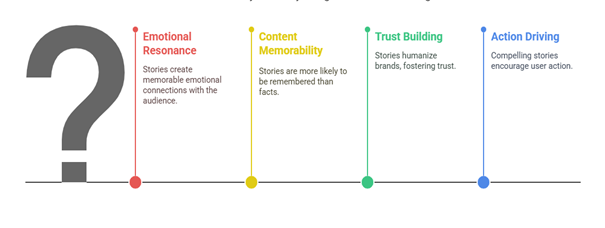
Evokes emotion: While people might forget the exact words you used, they will remember the emotions that have been sparked by the story.
Recall: The narrative content is up to 22 times which is more likely to speak in someone’s memory compared to plain data or facts.
Builds Connection: By believing in real, human experience in your message, storytelling makes friends feel relatable and genuine.
Encourages action: Crafted story guides towards making decisions and following the page, sharing content with enhancing the purchase.
Crucial Elements of a Brand Story Built Through Storytelling with Data
An impactful marketing story goes beyond simply describing a product, it invites into the impactful journey. However, when the story states some of the forms, most of the persuasive ones usually share a few essential elements.
1. An authentic character (respective customer)
Your story should reflect the goals, experiences, and challenges of your target audience. Let the customer be the main role- your brand is not the main aspect, but the supporter. Besides, when people see themselves in the narration, they are more likely to connect emotionally.
2. A challenge or obstacle
What hurdle does your customer face? This creates the tension and purpose of the story, setting up your offering as the solution. Therefore, the more real and emotionally resonant the issue, the more engaging the story becomes.
3. A great outcome or a change
Here is where your brand steps in to steal the spotlight, but to empower the hero. Moreover, such products or services that help to overcome the customer’s struggle and growth towards greater transformation.
Demonstrations of storytelling
Generally, storytelling in content marketing doesn’t have to involve videos or lengthy articles. Sometimes it is a straightforward method for the customer to share their experience and capture the brand’s produced mini document.
Stories of customers: An authentic account where clients describe their problems and how the product or services are provided as a great solution.
Behind the brand glimpse: Offer a look into the company’s day-to-day schedule, which introduces team members, shares their obstacles, and highlights the work.
The journey of the founder: Tell the story of how and why the business began. People are drawn to meaningful beginnings hardship, ambition, and purpose.
Real-world use case: Present your product within a familiar and everyday situation where it demonstrates the natural fit into the audience’s living.
Storytelling with Data in Marketing Campaigns
Integrating Storytelling with Data Across All Content Channels
1. Social media tool
A brief and compelling story with videos and relatable captions. Besides, featuring user-generated content builds trust and touch for the brand.
2. E-mail campaigns
Create storytelling in your welcome emails and create a stronger connection with the brand. In addition, present the message in a larger part to engage the audience.
3. Landing pages
Even persuasive sales pages benefit from the part of storytelling. Instead of opening a list of features, begin by highlighting the problem of the audience and guiding them towards a suitable solution.
4. Blog articles
All articles are helpful in your institutional or informative content. Instead of simply listing the advice, set a real-life scenario that illustrates a great solution.
5. Audio and video content (podcast)
These formats are useful for perfect storytelling, offering room for the emotional aspect and narratives. Whether it’s the behind-the-scenes clip or a feature of the customer, they let you focus on your story.
Practices for developing compelling stories
Storytelling in content marketing is not only about being creative, but it also requires a clean approach. Here is how to make your stories align with the objective of the brand.
Know your audience: Customize your characters, tone, and narratives to fit the needs and preferences of customer segments.
Incorporated data: Blend the storytelling with real statistics to understand the credibility of your audience.
Align with your brand values: Ensure every story reflects the core principles and mission of your brand.
Be genuine: Authentic camera raw stories often have a strong impact on polished ones. Embrace imperfections and don’t shy away from sharing obstacles.
Finish with a clear call to action: After captivating your audience, lead them towards the next logical step, whether it’s signing up, making a purchase, or engaging the further steps.
Assessing the effect of storytelling with data: While storytelling is often associated with branding, it produces tangible and measurable outcomes. For instance, these are the steps to evaluate its impact.
Engagement Analytics: Analyze data like time spent on social shares, time spent on page, bounce rates, and comments to engage the interest.
Response Rate: Calculate whether story-driven content leads to an increase in purchases and reactions.
Customer Reviews: Monitor if users are referencing your story for their content and social media posting.
Brand retention: Utilize surveys on social media tools to assess how effectively your brand message is remembered.
In the digital landscape, it’s compelling stories that cut through noise and leave a lasting impact. When you learn to tell stories effectively, the brand becomes more credible and unforgettable.
Harness the power of storytelling with data—Start building content that drives the best results
Begin by mapping out the audience’s experience and crafting stories based on their emotions and struggles. It ultimately leads to a great solution. Whether crafting a blog, launching an initiative of short films, or marketing strategies, a well-told story can turn into meaningful engagement to effective results. WebTrex Software encourages brands to increase their online presence with innovative solutions and information-driven strategies. As a web development company, we focus on storytelling with data to help businesses create compelling data to increase brand visibility and provide digital marketing services.
Keywords
Storytelling with data, Marketing campaigns, Landing pages, Informative Content, brand glimpse
Relevant Articles
How to craft a winning Social Media Strategy for your Brand
Read More about the Topic
The power of storytelling versus word of mouth A critical analysis in marketing and branding


